When sales feel slow, it's tempting to blame the end of the conversation. You look for a better script, a stronger ask, a smoother close. But the close is usually where the problem shows up, and it's rarely where it started. It started with who you chose to talk to, and how long it took you to figure out whether they were a fit.
This week I want to teach you one idea that changes where you spend your effort: you don't have a closing problem. You have a prospecting problem, or a qualifying problem.
Qualified prospects are scarce
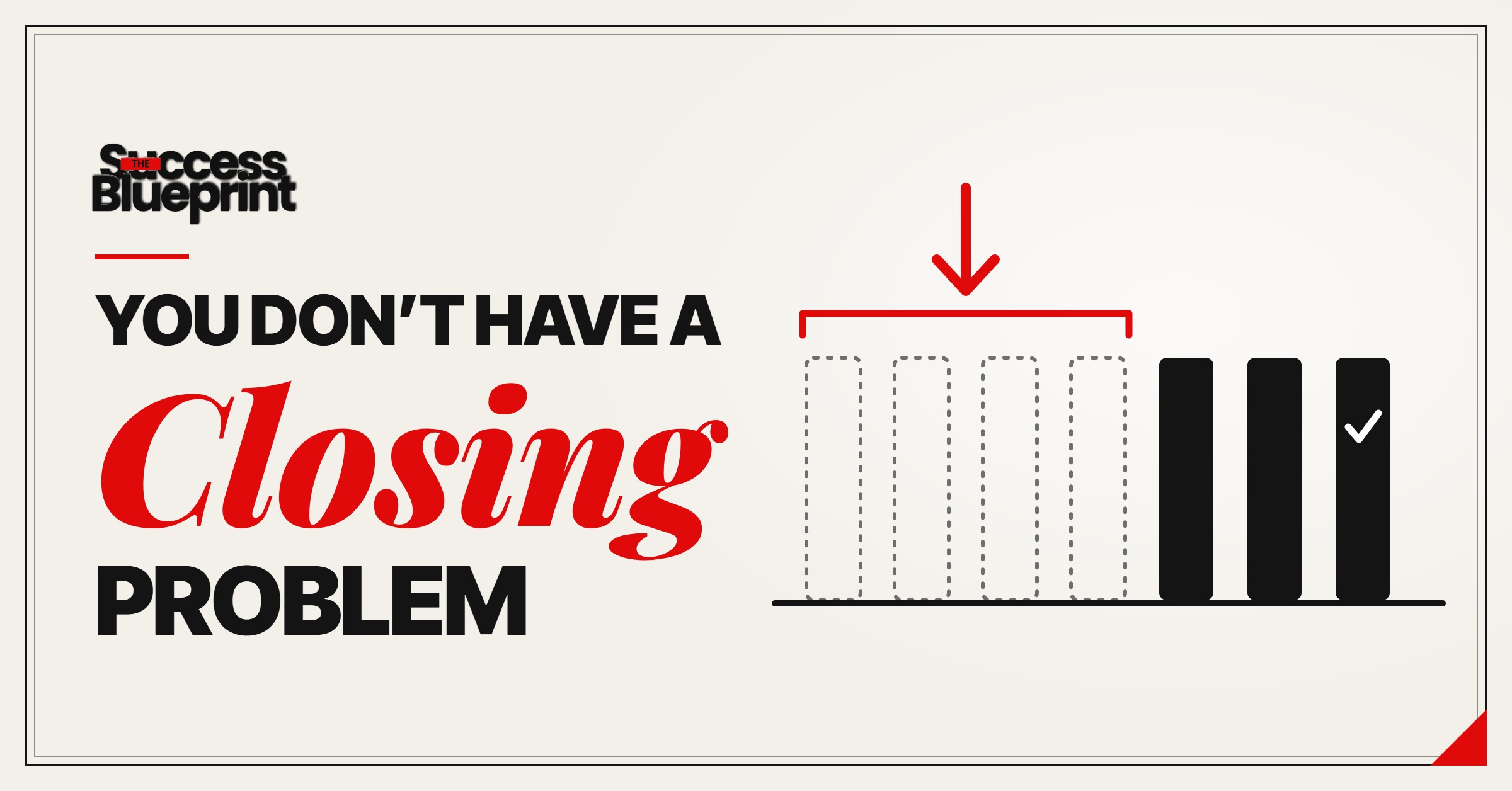
Start with simple math. If your yes number is 10 to 1, you hear 10 no's for every yes. That means only about 10% of the people out there are really a fit for what you offer.
So here's the question I want you to sit with: "Do you want to spend time with the 9 who won't close or the 1 who will?" Everyone picks the 1. And yet, if you've got enough time to spend with 9 people who won't, you've got enough time to spend with 9 people who will.
That's what qualifying is. It's figuring out, as early as you can, which person in a group of 10 is the one who's likely to say yes. The sooner you can spot that person, the sooner you stop worrying about the other 9. You spend your time with that one, and you start getting more yeses faster.
A full pipeline gives you the right to be picky
Being picky only works when you have people to choose from. A full pipeline gives you the right to be picky about who you spend your time with. Without it, you'll hold on to every conversation, because it feels like the only one you've got.
So the order matters. First, go get a whole bunch of prospects. Talk to everybody. Fill it all the way up, do as much as you can, and then you can become picky.
Be stingy with your time
The people who perform at the highest level are stingy with their time. They put their hours into the opportunities with the highest probability. They're disciplined enough to walk away when that probability drops, and they don't cling to deals they shouldn't be chasing.
This is a freedom question as much as a business one. If you want to be stingy with your time, so you get as much time as possible to do whatever else you love doing, you've got to fill your pipeline and learn how to qualify fast.
I hold myself to this. I'm A-OK with not calling somebody back who hasn't responded to me after two or three times. The second I see the probability drop, I'm fine with closing it right then, and I move my time to someone who's ready.
How to qualify: ask better questions
Qualifying comes down to one skill. You need to learn how to qualify as fast as possible, so the people who aren't going to say yes come out early. You do that by asking the right questions. The right questions are what help you qualify, and they let you see who the 1 is before you've spent weeks with the 9.
The common mistake
The mistake is treating a low yes rate as a closing problem. If your closing rate is around 2%, 2 out of 100 people, a better closing line won't fix it. "It's not a closing problem, I promise you. It's a prospecting problem. It's a qualifying problem." Either you aren't talking to enough people, or you aren't sorting them well once you do. Stop meeting with the people who were never a fit, and figure out how to ask better questions.
Your plan for this week
First, fill up. Talk to more people this week than feels necessary, so that you have real choices instead of one or two names you can't afford to lose. Second, write down the questions that tell you early whether someone is the 1, and ask them in your very first conversation instead of saving them for the end. Third, set your walk-away point before you need it. If someone hasn't responded after two or three tries, let it go and give that time to someone who's ready to say yes.
If you know someone who keeps blaming their close, send this to them. The fix might be a lot earlier in the conversation than they think.