If your income goes up one quarter and down the next, two ideas explain why that happens and what to do about it. The first is the law of need, which shows you what an empty pipeline does to the way you think and speak. The second is the 30-day rule, which shows you when the work you do today actually pays off. The law of need is one of the ideas that revolutionized prospecting for me, and by the end of this you'll know how to use both of them starting this week.
The law of need: an empty pipeline makes you desperate
The law of need governs desperation. When you have a need, especially when your pipeline is empty and there's no money coming down it soon, you become desperate. Maybe you're running low on funds. Maybe you quit your job and now you're relying on this business. Whatever the case is, if your pipeline is empty, you're going to become desperate, regardless of how noble your reason is.
The law of need tells you that the more you need something, the less likely you are to get it. Once you're desperate for sales, clients or business partners, every result in your mind turns into "I have to get this." I have to get a sale. I have to get a new client. I have to build a new relationship. All of that is negative, and all of it is desperation.
I know this one from the inside. After I separated from the Marine Corps, I didn't have a job or a steady income, and life became a daily battle for survival. For months I couldn't find a job that really generated any income. I had to rely on DoorDash just to make ends meet, and I ended up with an eviction notice at my door. My immediate reaction was, why is this happening to me? Even after I started my business, there were times my financial results felt embarrassing. I didn't want to run meetings, I didn't want to talk to clients, and I didn't want to prospect anyone. I just wanted to sit with my disappointment, and that's exactly the moment the law of need takes over.
Taking care of your family is a very real reason to want to make money. The danger is what happens to your focus when that reason turns into a need. The negativity that you focus on is exactly the negativity that you're going to get.
When you become desperate, you become a salesperson. It changes your emotions, how you speak and the way you think, and there's just a filter of desperation on all of it. I've seen this happen to myself.
What desperation sounds like in a conversation
The law of need does most of its damage inside your conversations. When you need a deal to pay your rent, the conversation stops being about the person in front of you. Now this prospect is about you paying your rent or not. What sort of emotional control are you going to have then? If they say no, it lands on your rent, your bills and your whole month. You lose emotional control, and when you lose emotional control, you lose the sale. The person with the greatest emotional control wins the outcome.
The most common way it shows up is talking too much. In that moment of weakness, you start talking and talking, because part of your brain believes that as long as you keep talking, the prospect can't reject you. You over-explain yourself. You bring up objections they never raised. The person who was ready to say yes gets talked into saying no, by you, and it's your insecurity that pushes them away. My advice here is simple: "Ask, and shut up."
Remember that the person who is asking the questions is the one in control of the meeting. And here's a truth that will change every sales conversation you have: whoever speaks the most leaves the meeting happiest. Most salespeople get this backwards. They spend forty-five minutes talking about what they can do, and the prospect leaves feeling like they sat through a presentation they didn't ask for. The salesperson leaves feeling great, then wonders why the prospect never follows up.
How to stop needing people
Avoiding the law of need means you stop needing people in your pipeline. You do that by focusing on how you can start helping people instead.
This is very important, and it's also very hard. The thoughts will still come: I've got to pay my rent, or I'm going to lose my house. Put that aside. Tell yourself you'll figure it out some way, shape or form, and then ask yourself one question: "Who can I help right now?" It's not about you. I don't care what the situation is or how long you've been grinding, there's always a different perspective you can lean into, so pivot your focus to the person you can help.
When you walk into a conversation to help, your job is to figure out what the person needs and whether you can help them get it. That's what selling really means to me. You become their advocate for the value they need, and when your intentions are clear, selling becomes serving.
"Be a business person, not a salesperson." Salespeople are going to sell you something. Business people have value that they want to provide to you. That's the difference, and it's the standard to hold yourself to in every conversation.
The last part of this mindset is how you think about results. You have to marry the activity and divorce the results. You control how many people you talk to and how well you serve them. You don't control whether any one person says yes, so stop letting one answer decide how you feel about your whole business.
Keep the pipeline full
Your mindset is only half of this. To never fall into the law of need, make sure your pipeline is always full. You do that by prospecting continuously, in both the fast lane and the slow lane I covered in last week's article. When you've got people in the pipeline, you don't have to worry.
Failure to prospect is the number one business killer. Prospecting is the only thing you must do in any business, and everything else is optional. It looks different in every business. For a local restaurant owner, it looks like inviting people to come try your newest entree. In media, it looks like pitching people to watch your new show. As an affiliate for a TikTok brand, it looks like messaging the people who liked your video and asking what part resonated with them most. The method changes, but the principle doesn't: you must consistently invite people into your world.
I learned this one the hard way too. When I started my business, I was having meetings with everybody I knew. After three weeks, I ran out of people I knew to meet with, so I started going on LinkedIn. Everyone's personal network runs dry at some point, and the people who keep growing are the ones who start reaching new people before it does.
Here are four habits that keep the pipeline from running dry.
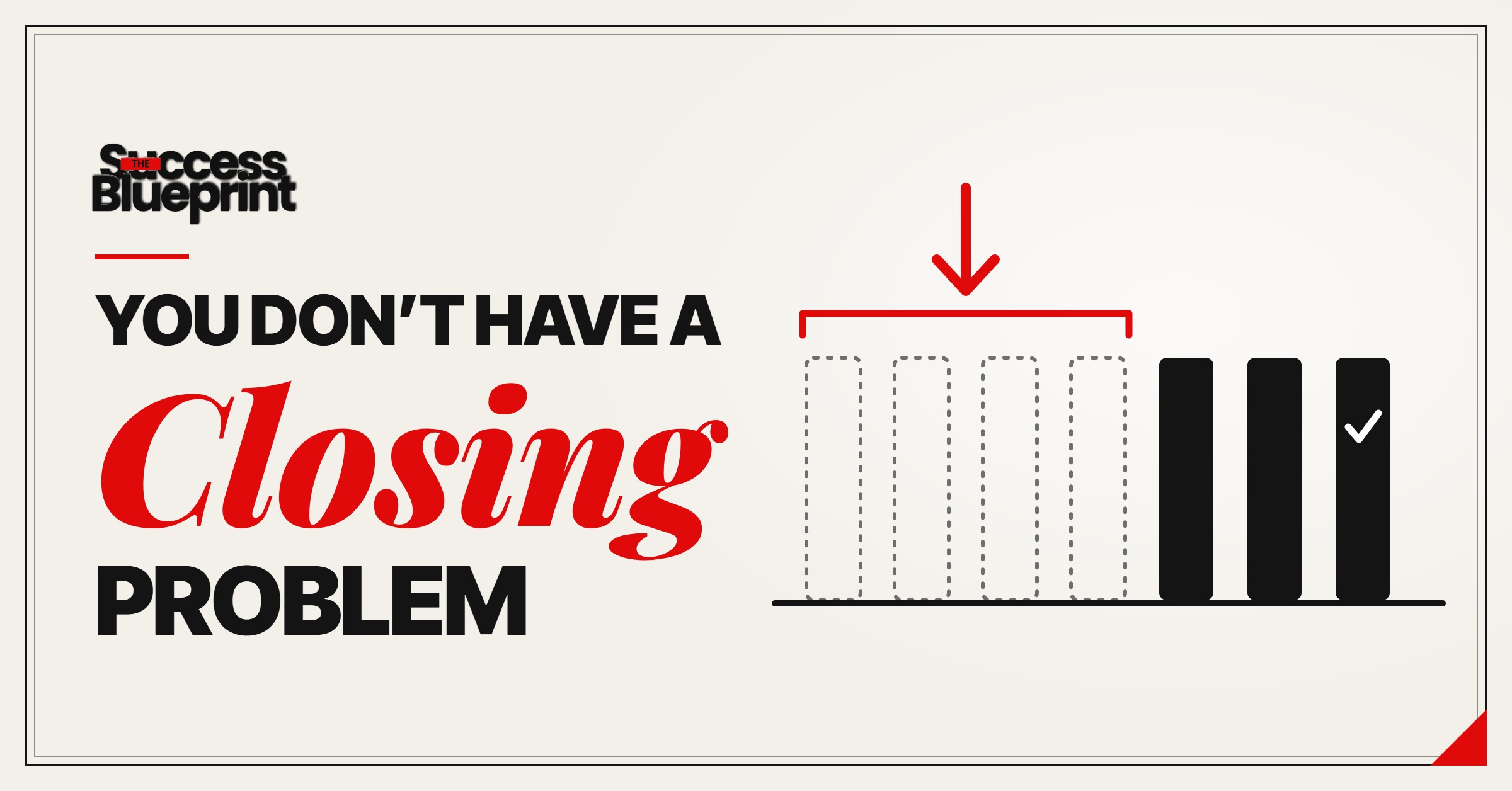
The first is what I call the law of replacement. As soon as you close a deal, go get more. If you close one out of every two people you talk to, then every time you close one, you need to go talk to two more people right away. That's how you keep the pipeline full while you're winning.
The second is knowing that yes has a number. Your yes number is a lot like your closing ratio, and it's a real statistic. If you ask enough times, in the right ways and at the right moments, you eventually get a yes. Once you know your number, a single no stops feeling personal, because it's just part of getting to the next yes.
The third is the 10-to-1 rule. For every 10 prospecting messages you send, have one normal conversation without trying to prospect that person at all. We so easily dehumanize people on social media and try to get straight to business, so just talk to them about them.
The fourth is follow-up. Never leave a meeting without scheduling the next one, because momentum dies when you leave without a firm next step. And if someone goes quiet on you, keep following up. A person stays in your pipeline until they clearly tell you they're not interested.
Keep in mind that activity without productivity is just expensive busy work. All four habits exist to turn your conversations into real next steps.
The 30-day rule: this month pays off over the next 90 days
The rule is simple. What you do in this 30-day period pays off over the next 90 days. So if you do nothing in your business for the next 30 days, guess what your next three months are going to look like? Absolutely nothing. If you don't want May, June and July to be bad months, you've got to prospect in April.
When you look back and say you haven't been making any money, ask yourself what you did 90 days ago. If you didn't do anything, that's why. "It's not that the business doesn't work. It's just that you didn't work."
You can only answer that question honestly if you track your activity. Track your daily habits and measure what you've achieved, because otherwise you'll operate based on feelings, and how you feel is always substantially worse than reality.
I hold myself to this rule too. Whenever I'm tempted to slow down, I remember that if I slow down, it's going to play out for 90 days, and that's not what I want for my business. It took me a long time before I started making real money, and what you don't see when other people are winning are the months they made no money and the years it took for things to actually click. Staying in the game long enough is what lets the results compound.
This is also why a gap costs you more than you'd expect. If you do a bunch of activity in October but no activity in December, then January, February and March aren't going to be good. You have to chain your months of prospecting together, so that you never have a bad 90-day period.
The blitz trap
If you don't chain them, your income goes up, down, up, down. Trust me, I've done it myself, and here's how it happens.
You go on an all-out blitz and go crazy for a whole 30 days. Now you've got all these names and numbers and all these appointments, so you legitimately don't have time to prospect. It'll take you about two or three months to work with all those new contacts, and meanwhile you're not putting new contacts into your pipeline. For every deal you close, your pipeline shrinks a little more and gets closer and closer to zero. Your pipeline dries up, and then you have a really bad quarter.
The mistake is letting your good month stop your prospecting. The busier your calendar gets, the more you need to protect the time you spend adding new people to it.
It's easy to get patience backwards here. A lot of entrepreneurs become patient with their own mediocre execution: the way they generate activity, the way they communicate, the way they sell and the ten reasons last week was a wash. Then they become impatient with the things that take time to mature regardless of what they do, like their pipeline and their skill. They demand unrealistic speed from results while accepting complacency in the activity that produces those results. That's the burnout engine. Be impatient with your activity and patient with your pipeline.
The answer is consistency, and consistency doesn't have to mean every single day or every single hour. It means your pattern stays the same. Whatever cadence you set for yourself, keep it steady, so you never leave any holes in your pipeline. Consistency is when you wake up and don't feel like it, and you still do what you told yourself you were going to do.
Your plan for this week
First, look back 90 days. Ask what you did in that 30-day period, notice how closely it matches what's happening in your business right now, and start tracking your activity today so you never have to guess again. Second, put your prospecting time on your calendar for each of the next three months, keep it there even when you get busy, and every time you close someone, go talk to new people right away. Third, the next time a need starts running your thoughts in a conversation, put it aside, ask who you can help right now, and then ask your question and let them talk.
Keep your pipeline full so you never need anyone in it, and this month's work will take care of the next 90 days.
If this was useful, send it to one business owner you know whose income keeps going up and down.